Heated Rivalry and Shakespeare in Lust

I generally manage to accidentally scandalize my students about 30 minutes into my second tutorial, when I forget that THIS is going to be the year that I don’t swear in the classroom. However, the single largest shock I have ever given a student didn’t actually occur in my classroom at all — I was visiting another tutorial and a student happened to ask me my opinion on the passage they were studying:
ROMEO. If I profane with my unworthiest hand
This holy shrine, the gentle sin is this:
My lips, two blushing pilgrims, ready stand
To smooth that rough touch with a tender kiss.
JULIET. Good pilgrim, you do wrong your hand too much,
Which mannerly devotion shows in this;
For saints have hands that pilgrims’ hands do touch,
And palm to palm is holy palmers’ kiss.
ROMEO. Have not saints lips, and holy palmers too?
JULIET. Ay, pilgrim, lips that they must use in prayer.
ROMEO. O then, dear saint, let lips do what hands do.
They pray: grant thou, lest faith turn to despair.
JULIET. Saints do not move, though grant for prayers’ sake.
ROMEO. Then move not while my prayer’s effect I take.
[He kisses her.]
Thus from my lips, by thine, my sin is purged.
JULIET. Then have my lips the sin that they have took.
ROMEO. Sin from my lips? O trespass sweetly urged!
Give me my sin again.
[He kisses her.]
JULIET You kiss by th’ book.
(All quotes are from Folger; slightly reformatted)
There’s a few things that can be said about this passage: it’s a sonnet, for one — form and content merging together to show immediately how in tune with each other the young lovers are. When Romeo and Juliet interweave rhyme and trade images of pilgrimage and prayer back and forth between them, they play a complicated linguistic game — share a sophisticated and decidedly literary flirtation — that establishes them immediately as creative and emotional equals and as people who are well-schooled in what love should look like. At the time of Romeo and Juliet’s first performances, the sonnet was a developing form, generally seen as reserved for the highest exclamations of love, and fashionable. By this point in the play, Shakespeare has mocked the sonnet already, through the character of Mercutio, and will do so again; he likewise takes aim at lover-poets in Much Ado About Nothing. The poems that Orlando nails to trees in As You Like It might be sonnets, and though Orlando does get the girl in the end, his wrestling makes more of an impact than his literary efforts. But Romeo and Juliet, unlike Benedick or Orlando, are excellent sonneteers. In their first meeting, Romeo and Juliet use constructed, stylized, and contrived language tremendously effectively. Their speech is artificial in the most positive sense of the word: skillfully crafted and deliberately aesthetic. This is the closest you can get to stained glass in dialogue. This is romance “by the book”.
This is, of course, not what I said. What I said was:
“Well, it’s pretty sexy, isn’t it?”
My partner and I received recently one free year of Crave TV. It’s been fine. Clueless is on it, which is nice. Clueless is a great movie, particularly when you are getting it for the extremely low price of $0.00 CAD. I watched Clueless and was generally content and had no intention of opening the app again.
And then I heard the phrase “Canadian government funded hockey smut”, and, after several minutes of googling, learned about Heated Rivalry, a smash hit on streaming, which has been featured by The Washington Post, CNN, Cosmopolitan, and The Guardian — and, obviously, because it’s Canadian, by CBC, The Toronto Star , and The Globe and Mail.
Based on the end credits, a total of five national and provincial Canadian government agencies were involved in funding in the show, which is based on a book in which the first sex scene occurs thirty-eight percent of the way into the prologue. (Like any good English major, I read the book first. If you’ve never read romance before, I would start elsewhere. If you’re my mom, I’ve never heard of any of this.) It is directed by Jacob Tierney, one of the guys behind Letterkenny. This poster of it is possibly the single most misleading bit of advertising for a television show I’ve ever seen:

Somebody, somewhere, clicked on this, and got the surprise of their lives. One can only hope that they enjoyed it.
I imagine that many people find the mere existence of Heated Rivalry very shocking, for reasons I think are intuitive. Hockey is an incredibly homophobic, misogynistic sport. A large part of the marketing around the show contrasts this oppressive atmosphere with the show’s explicit sex scenes — a technique which deliberately courts controversy, especially because sex scenes in movies and televisions are not as common as they used to be. One of my favourite essays on the subject is “Everyone Is Beautiful and No One Is Horny” (An essay which might be worth revisiting with Heated Rivalry in mind, depending on how certain plot lines play out — I’m wondering if the show will actually do anything interesting with the implied disordered eating of one of its protagonists). The old adage of “Sex Sells” is challenged by news headlines like “Almost half of gen Z viewers want less sex on screen, study finds”. Those gen Z viewers probably shouldn’t watch Heated Rivalry. There is a lot of sex in Heated Rivalry.
Heated Rivalry aims to be “titillating” — that’s not my word, that’s Tierney’s phrasing. And a little scandal goes a long way in attracting interest. I think that’s part of the fun of the phrase which initially caught my attention: can you believe that our tax dollars went to this? (More of my tax dollars should go to this, honestly. I’d rather have more critically acclaimed government funded smut than government funded attacks on bike lanes.) I certainly started the first episode of Heated Rivalry ready to be a little scandalized.
But I wasn’t.
The editors of the Folger have helpfully made explicit in a stage direction what is implied by the dialogue, namely when in the scene Romeo kisses Juliet. These stage directions are editorial emendations — they do not exist in the scene as it appears in the first Folio version or the first or second Quarto versions.
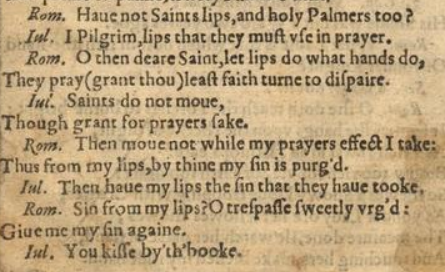
This is an image of an excerpt from the First Folio — you can see that there are no stage directions. You can see the full page here. Or, you can page through scans of other versions of the text here.
Early readers were expected to make the interpretive leap from dialogue to action, or perhaps they were expected to remember what they’d seen on stage. Romeo and Juliet was a tremendously popular play — in The Shakespeare Company, Andrew Gurr notes that it was being quoted by students by 1597. This is around the time the first quarto was published, but these students, in my opinion, were likely quoting from memory of something they’d seen rather than something they’d read, in exactly the same way I tell my partner “Way harsh, Tai” when he tells me I dance like an Animal Crossing character.
Folger’s emendations are a way of trying to make a reader “see” the action by making certain actions explicit. A reader doesn’t technically need them, because the dialogue tells you what’s happening. This is called an implicit or implied stage direction. To an experienced reader of Shakespeare, Romeo’s “Then move not while my prayer’s effect I take” serves the same purpose as “He kisses her”. This is a dramaturgical move that carries with it significant character implications. Does Romeo announce what he is going to do before he does it to allow Juliet time to protest? She not only does not protest, but baits him into a repeat performance: hence the subsequent kiss after the implied stage direction of “Give me my sin again”.
What an editorial emendation like “He kisses her” can do to a novice reader of Shakespeare is disguise the other important actions hidden in the dialogue, because it teaches readers to think of acting cues and speech as distinct. It trains a reader to expect that if a certain action is truly important in performance, it will be specified as occurring in a stage direction.
There are other implied stage directions in the Romeo and Juliet meeting scene. Here’s a version of the scene where I’ve made all the ones I think are most arguable explicit:
ROMEO. [He touches her.]
If I profane with my unworthiest hand
This holy shrine, the gentle sin is this:
My lips, two blushing pilgrims, ready stand
To smooth that rough touch with a tender kiss.
JULIET. Good pilgrim, you do wrong your hand too much,
Which mannerly devotion shows in this;
For saints have hands that pilgrims’ hands do touch,
[She places their palms together]
And palm to palm is holy palmers’ kiss.
ROMEO . Have not saints lips, and holy palmers too?
JULIET. Ay, pilgrim, lips that they must use in prayer.
ROMEO. O then, dear saint, let lips do what hands do.
They pray: grant thou, lest faith turn to despair.
JULIET. Saints do not move, though grant for prayers’ sake.
ROMEO. Then move not while my prayer’s effect I take.
[He kisses her.]
Thus from my lips, by thine, my sin is purged.
JULIET. Then have my lips the sin that they have took.
ROMEO. Sin from my lips? O trespass sweetly urged!
Give me my sin again.
[He kisses her.]
JULIET You kiss by th’ book.
You might also say that it should be:
ROMEO. [He touches her.]
If I profane with my unworthiest hand
This holy shrine, the gentle sin is this:
My lips, two blushing pilgrims, ready stand
To smooth that rough touch with a tender kiss.
[He kisses her hand.]
JULIET. Good pilgrim, you do wrong your hand too much,
Which mannerly devotion shows in this;
For saints have hands that pilgrims’ hands do touch,
And palm to palm is holy palmers’ kiss.
[She places their palms together]
Here’s one way the scene is performed, and you can see how the implied stage directions work in action:
Another performance of the same scene:
This flirtation in this scene is literary, but it is also physical. Romeo and Juliet touch each other and dare each other to escalate the action. Crucially, it’s mutual: the current implied directions give all the agency to Romeo: “He kisses her”. Surely, by the second time, it should be “They kiss.”
I asked my partner at what point in Heated Rivalry he thought an uninformed viewer would twig to the nature of what they were watching. He thought it would be this scene, which happens to be the scene that Crave released as a sneak peek:
Here is that scene, written out as if it’s a play from the Early Modern era (how we generally describe the time period roughly contemporaneous with Shakespeare), though I’ve taken liberties to modernize and standardize the spelling:
ILYA. Whoo!
What a fucking day, huh?
SHANE. Yeah, Totally.
ILYA. Is everything you dreamed of?
SHANE. Almost.
ILYA. Sorry.
SHANE. No, you’re not.
ILYA. Montreal is — is nice, yes?
SHANE. Yeah, it’s awesome
ILYA. Boston is nice too?
SHANE. I think so. People like it there.
ILYA. We will be seeing each other a lot.
SHANE. Yeah. Boston and Montreal play against each other often.
ILYA. More.
Wait, you might say, that can’t be right. In a contemporary play, you’d expect there to be more stage directions:
ILYA. We will be seeing each other a lot.
SHANE. Yeah. Boston and Montreal play against each other often.
[Ilya offers him a water bottle. Shane denies, then accepts, and drinks.]
ILYA. More.
[Shane drinks.]
If there’s no stage direction there, how are you supposed to interpret the “more”? It just occurs, with no context. But practices for stage directions are notoriously uneven in this time period. This, combined with inconsistent spelling, printer errors, and a very different theatrical production process, results in textual cruxes where contemporary editors must interject to shape the text for their readers — often in the form of interjections like “He kisses her”. In our hypothetical Heated Rivalry case, the editorial interjection is needed for comprehension even more than in the Romeo and Juliet case above. But even with the interjection, the reader loses the key performance details that elevates this scene past the surface level of two guys hanging out in the gym. If you weren’t expecting this scene to be sexy, you simply wouldn’t see it.

The words used by Romeo and Juliet during their sonnet flirtation are scandalous — they use religious language to express sexual desire. Images of purity and prayer mask a rather more profane drive. The interplay is deliberate, provocative, and is enhanced by the slow ramp up of physicality between the characters. The scene is designed, to borrow Tierney’s words, to titillate. It is erotic— but unlike Heated Rivalry, which is likely to be consumed in the relative privacy of your own home, most readers of Romeo and Juliet will encounter it in a school setting.
Romeo and Juliet is hugely popular in the education system because it’s viewed as inherently attractive to young people — because of its focus on forbidden love, because of its relatively simple plot, because the protagonists are young themselves. I know someone who, due to a lack of teacher communication, read it in four different classes before he graduated high school. The idea that this play is for young people in ways that, say, King Lear isn’t impacts the way it is taught. In a classroom setting, Romeo and Juliet can be allowed to be about love — but if you’re a grade nine English teacher teaching fourteen year olds, are you going to be comfortable talking about how the play is also about sex? I think it is important to note that the sex in Romeo and Juliet goes beyond dirty jokes, which, in my experience, translate well and aren’t difficult to teach. Mercutio’s sexual wordplay is easy. Are Juliet’s last words so easy?
JULIET . Yea, noise? Then I’ll be brief. O, happy dagger,
This is thy sheath. There rust, and let me die.
Any decent edition will note the sexual innuendo on “happy dagger”, “sheath”, and “die” (think of the French “petite mort”). But Juliet isn’t telling a joke here. She’s eroticizing her own death. Romeo also participates: when learning of Juliet’s (assumed) demise, he announces “Well, Juliet, I will lie with thee tonight.” Sex saturates the play.
Students come to a Shakespeare class expecting great literature. They are not expecting things to be sexy. Or, if they are, they’re expecting the dirty jokes that their teachers assured them were there if they would just pay attention. They aren’t expecting heat — or, to borrow a phrase from contemporary romance — spice. When ranked using the Hopeless Romantic spice guide, Romeo and Juliet doesn’t come close to reaching the four to five chilli ranking of Heated Rivalry. But it isn’t a zero chili book like The Comedy of Errors or Julius Caesar. Act three, scene five — a fade in from black. Enter Romeo and Juliet aloft. They weren’t praying together.
One of the shocking aspects of Romeo and Juliet in this framing is Juliet’s age. It’s specified that her birthday is in about two weeks (on July 31st specifically) and she’s about to turn fourteen. This is a detail that is foregrounded and discussed, not tossed off in an aside. It’s also a change from Shakespeare’s sources, where Juliet is a little older, between sixteen and twenty.
It’s tempting to just write this off with “well, people were considered adults at younger age in Shakespeare’s time", but that is inaccurate. Juliet’s own father notes that he thinks she’s too young to get married (though her mother notes that she was pregnant at Juliet’s age, and Juliet’s father changes his mind). The average age at marriage in early modern England was in the mid-to-late twenties. Shakespeare’s wife was twenty-six (and pregnant) at the time of their marriage.
Of course, Shakespeare himself was eighteen.
According to the Oxford English Dictionary, the first recorded instance of the word “teen” to refer to age first appears in 1596 — right around the time of Romeo and Juliet’s first publishing. “Teenager” appears much later, in 1913. The preferred nomenclature for the stage between childhood and adulthood in Shakespeare’s time was “youth”. Youthhood started around puberty — and was considered to come earlier for girls than for boys — and lasted longer than it does today. A young man would only be considered a full adult after he completed his apprenticeship, which generally occurred at a minimum age of twenty-four.
Youth was considered to be a “hot” and “lusty” age. There was a strong age hierarchy, with the elderly at the top and children at the bottom. Words like “boy”, when applied to an adult man or youth, were insults — Tybalt and Romeo are the receivers of such an insult in the play.
For Shakespeare at least there was a strong association between youth and love. In As You Like It (emphasis mine):
JAQUES. All the world’s a stage,
And all the men and women merely players.
They have their exits and their entrances,
And one man in his time plays many parts,
His acts being seven ages. At first the infant,
Mewling and puking in the nurse’s arms.
Then the whining schoolboy with his satchel
And shining morning face, creeping like snail
Unwillingly to school. And then the lover,
Sighing like furnace, with a woeful ballad
Made to his mistress’ eyebrow…
Because girls entered youthhood earlier than boys, Juliet, at fourteen, is firmly in the youth category. Her verbal sophistication and dramatic force often cause her to be read on stage as a little older. Romeo’s age is not textually specified in the same way, but his behaviour and the fact that he still lives at home with his parents make it clear to me that he’s around the same age as Juliet, perhaps around the age of the average new apprentice, who would have been bound around 17. So though, Juliet is numerically young, she and Romeo are still in the same age category of a sizeable chunk of Shakespeare’s audience — the apprentices of London were notorious theatre goers, as the pandering title of the smash hit The Four Prentices of London attests. Arguably, she and Romeo are in the same age category as Shakespeare was when he married.
A fun game is to try to calculate the age of Shakespeare’s daughters when he’s writing Romeo and Juliet. Susanna, his eldest, would have been around 14 when it first appeared in print, but considerably younger when it was written if the earliest estimates are correct. If Shakespeare is writing at all from experience or observation, I don’t think it’s particularly strange to imagine that he might be writing from his own experiences of youth sexuality.
So, while it is inaccurate to say that at nearly fourteen Juliet would have been considered an adult, she would not have been a child either. She would have been, arguably, part of the age category that dominated society at the time. Paul Griffiths, in his book Youth and Authority: Formative Experiences in England 1560–1640, quotes a Bishop Goodman in 1616, who wrote that the average person looking around at the time “shall finde more living under the age of thirtie than above.” In his professional life, Shakespeare worked with youth actors: one candidate (a candidate popular enough to be on Wikipedia; and the candidate put forth by Sophie Duncan in her book Juliet: The Life and Afterlives of Shakespeare's First Tragic Heroine) for the first performer of Juliet is Robert Gough (or Goffe), who is estimated to have been around 15. The exact identity of the performer is speculative, as no contemporaneous-to-Shakepeare records exist, but the general importance of people Juliet’s age in the theatrical and public life of early modern England is not.
Our changing idea of what being a teenager means, and our experience of the play as a classroom text means that reading that Juliet was “only thirteen” (though I think most people two weeks away from fourteen would feel more affinity for the larger number) renders the sexuality in the play shocking and off-putting. But to the apprentices and other young people in Shakespeare’s audience, she and Romeo are simply a somewhat stylized representation of their own experiences — and these experiences definitely included sex, as the historical record proves. Court records for prosecution of fornication and records of illegitimate children provide concrete evidence that the lives of young people in early modern England were hardly chaste — and crucially, these are only the records of the people who got caught.
In many ways, Romeo and Juliet provide a bit of a blueprint for Ilya and Shane in Heated Rivalry. Much like Romeo and Juliet, Ilya and Shane exist in a high pressure situation that they have no real control over, positioned as rivals by the circumstances of their birth. There is a strong sense that their romance is forbidden by their cultural surroundings. They live in atmosphere of highly stylized violence. Even the homosexual nature of their desire might be viewed as indirectly inherited from the all-male casts of the Early Modern stage.
And, like Romeo and Juliet, Shane and Ilya are young and horny.
In the linked interview with Queerty above, Tierny says:
I just integrated the sex into the storytelling. It’s just part of how their relationship develops; these are two people who spend years meeting up three, four times a year and f*cking. They don’t talk a lot, and even when they do talk, it’s a lot of posturing and playing. So when they are actually communicating honestly it’s when they’re f*cking. And so that’s part of the language of communication and storytelling.
Queerty censored that word, by the way. Not me.
I think part of why Heated Rivalry doesn’t feel scandalous to me is that Tierny succeeds in his goal. The sex makes sense, both emotionally and in terms of narrative structure. It’s hard to imagine a version of this story where you can replace the sex with — I don’t know — going out for coffee? They’re in Canada — taking a romantic trip to the Stratford festival? Staying in and watching Clueless on Crave? Given the context — the ulta-competitive, quasi-violent world of professional sports, not disimmilar from the tense, inherently factional world of Verona — of course things are moving fast, intensely, and secretly. Romeo and Juliet takes place over less than a week, after all. Shane and Ilya, in that context, move practically glacially.
But it’s hard to be scandalized by sex on television when you put that sex into historical context — when you realize that there has always been the desire to put eroticism into art. When you’re reading through documents which are so removed from their original contexts, it’s harder to see. When you’re engaging with things in a classroom, either as a teacher or as a student, there are a million reasons to sweep it under the rug. But it is there.
The early modern theatre was a scandalous, shocking place. There were powerful forces of censorship at play — forces which actually won when the theatres closed in 1642. This cultural crackdown was inspired in part by a deep anxiety over the homoeroticism of the stage; you can see such an attitude in William Prynne’s 1633 Histriomastix, the full title of which is over 200 words long and froths with barely disguised panic over the possibility of — no, the inevitability of — moral corruption. In the text, Prynne announces his intent to describe the manner of acting on stage, and writes that he will examine in order:
First, the hypocrisie; Secondly, the obscenitie and lasciviousnesse; Thirdly, the grosse effeminacy; Fourthly, the extreame vanitie and follie, which necessarily attends the acting of Playes.
A few lines later, he writes “of the ordinary apparell wherein Playes are acted”, proclaiming them to be:
First of all, womanish, belonging [t]o the female Sex: Secondly, costly, fantasticall, strange, lascivious, whorish, provoking unto lewdnesse.
“Obscenitie?” “Lasciviousnesse?” “Effeminacy?” “Whorish?” and “Provoking unto lewdnesse?” — honestly? Sounds like a good use of my tax dollars.